Kids' goods e-shop — 14× more orders
A kids' goods e-shop case: 1000 SKUs in a single campaign, the assortment split into five groups, two campaigns and ROAS from 150 % to 450 %.
A small e-shop with a limited budget and the ambition to achieve a better return on its advertising investment (ROAS).
Its assortment held more than 1.000 products (SKUs), but it advertised them in a single campaign only, without any split by performance.
The main goal is to gain control over the advertising, improve measurement and reach ROAS above 250 %.
At the same time we wanted to prepare the ground for scaling sales – that is, growing the order volume without hurting the return.
About the e-shop
A kids’ goods e-shop (Czech Republic)
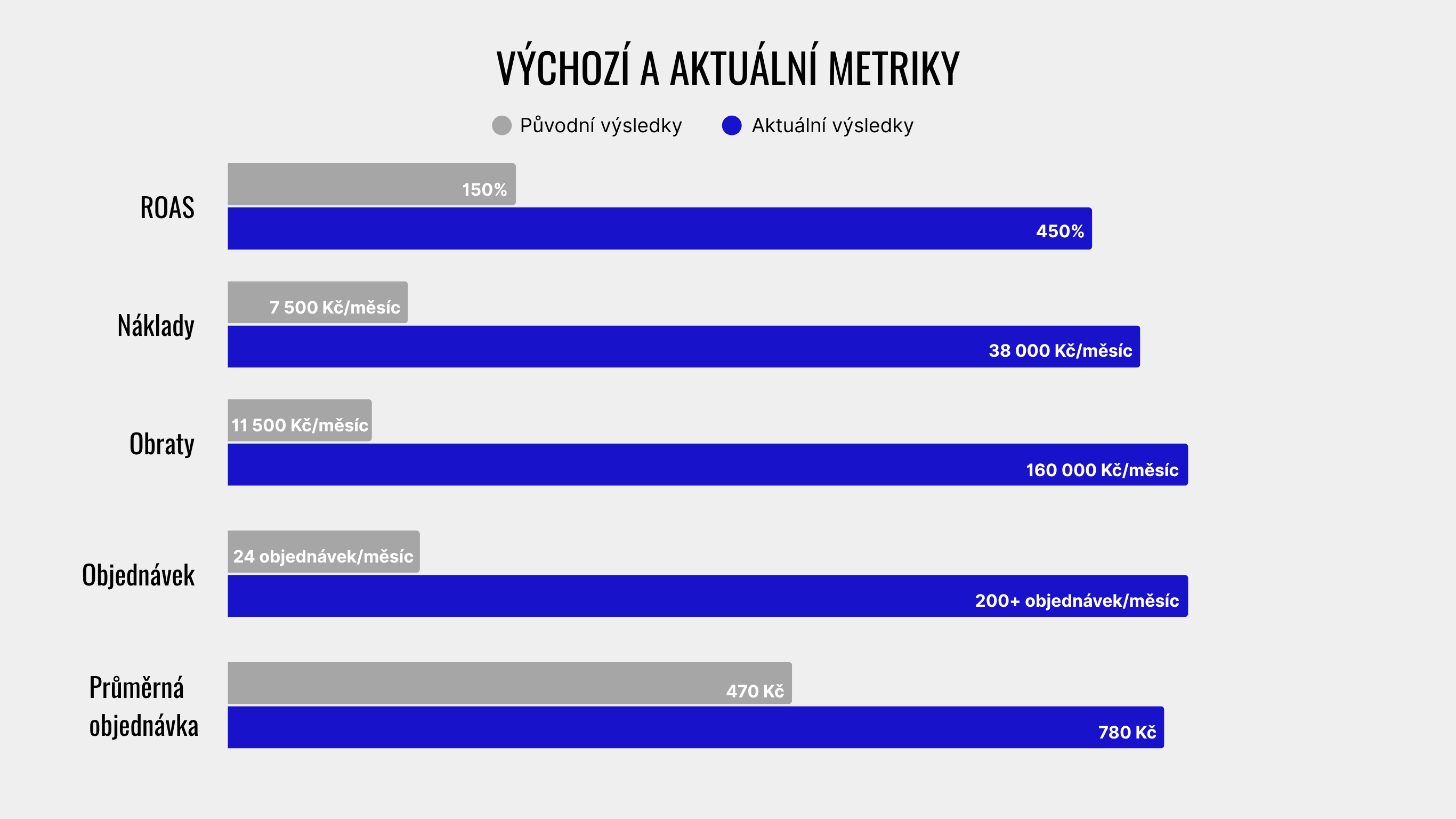
ROAS change: 150 % > 450 %
Monthly revenue change: 11.500 Kč > 160.000 Kč
- Category: Kids’ goods
- Size: growth from 30–50 to 50–250 orders per month
- Assortment: 1000 SKUs
The results we achieved by working with the assortment inside the advertising (GETPROFIT):
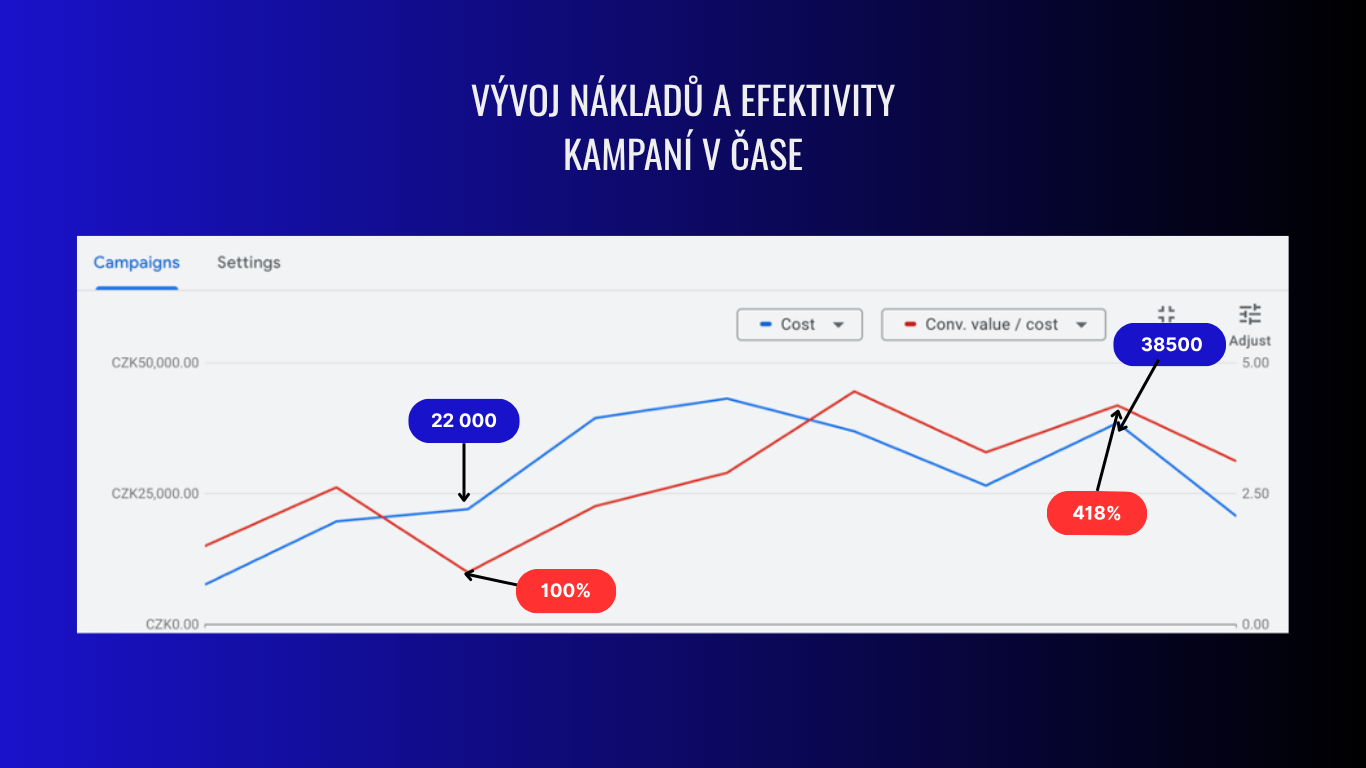
The chart shows two pronounced drops in performance:
- one at the start of our cooperation
- the other towards the end of the observed period.
Both declines had a technical cause in the analytics. The first happened when a new country was launched and the conversions could not be set up correctly straight away. The second drop at the end was caused by Consent Mode not being switched on, which led to incomplete data being passed to Google.
To give a better idea, here is what it looks like now, with Consent Mode set up correctly:
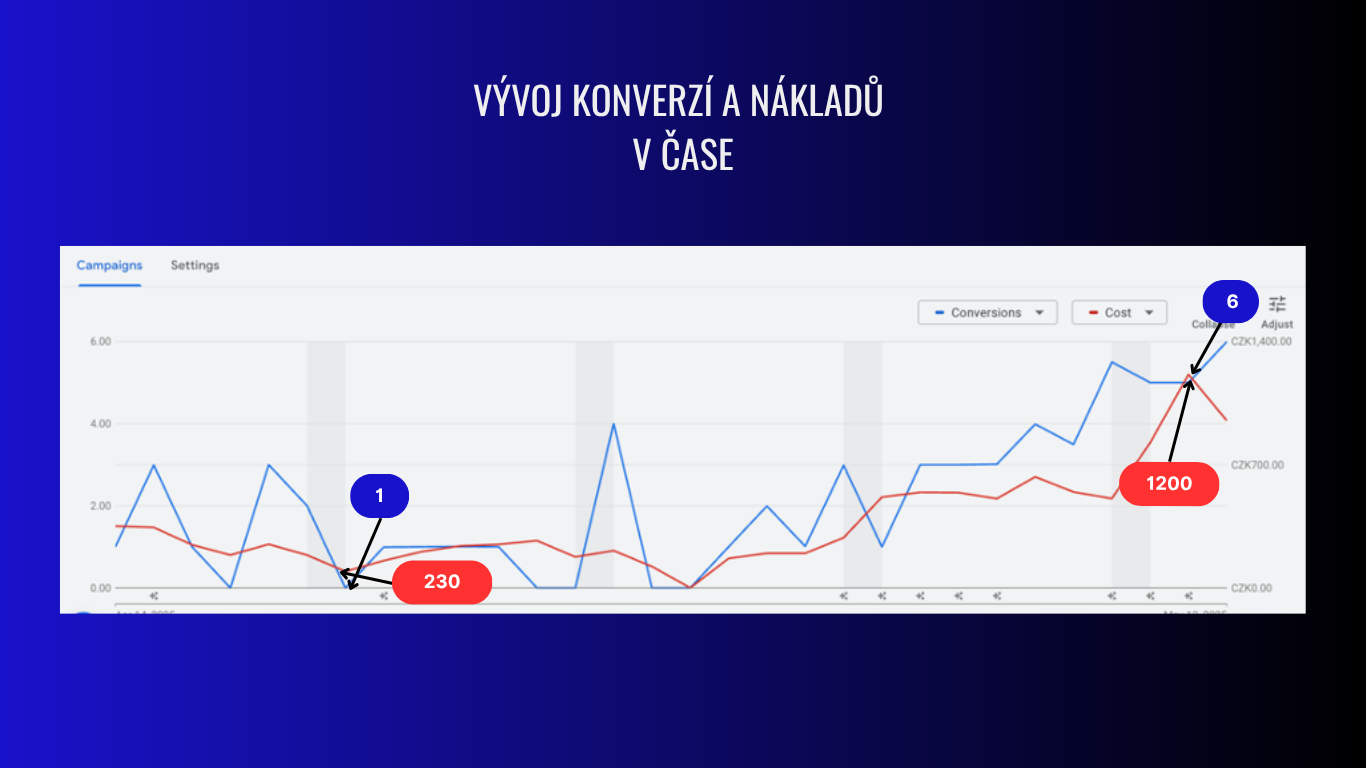
For Google it is very important that it receives the right data.
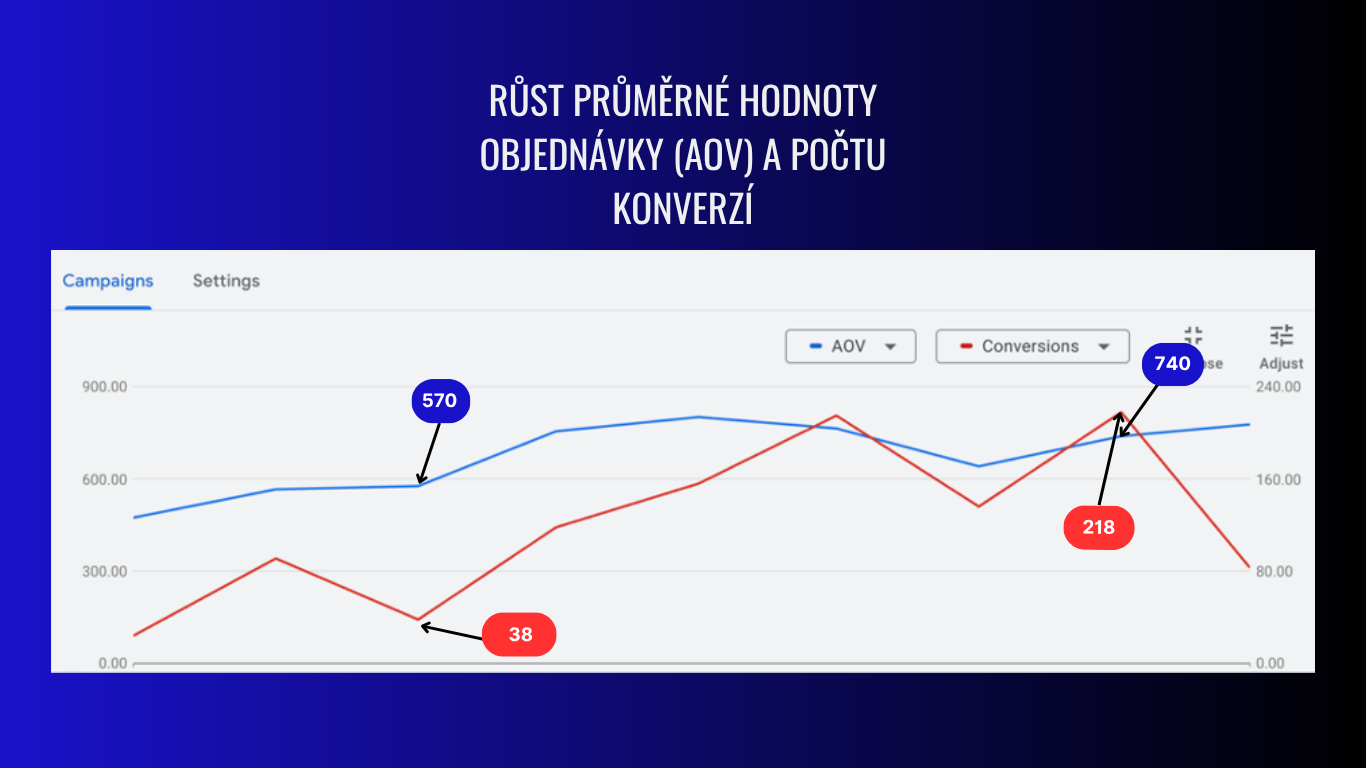
Step by step we managed to raise the average order value from 470 to 780 Kč and at the same time significantly increase the number of conversions.
What was done:
- Analysis of every product
- Advertising campaign structure
- Segmentation of the assortment by efficiency
- Optimisation of the advertising campaigns
Analysis of every product
Based on our algorithm we analyse every product in the advertising and split the assortment into 5 groups:
- Bestseller
- Potential bestseller
- Zombie
- Loser
- New arrivals
This step is fundamental for the further split of the budget based on the results of the individual items.
Products that bring sales and perform efficiently are the ones we want to support with more impressions, clicks and sales. Conversely, for items that “eat” our budget but do not bring the required results, we lower both the priority and the funding.
Advertising campaign structure
Our work does not end with splitting the assortment based on the analysis. We have our own algorithm that analyses the entire assortment completely and divides it into several segments by performance.
Based on this data we split the assortment into two advertising campaigns:
Campaign no. 1
Goal: maximise the number of conversions and the revenue at the target ROAS.
Segments: Bestseller, potential bestseller and new arrivals.
The campaign holds products we know sell well, plus new products among which we want to find further bestsellers.
Campaign no. 2
Goal: cut the cost of products from the Zombie and Loser groups so that they sell efficiently.
Segments: Loser, Zombie
We set the target ROAS or higher. Spend in Google grows only if the ROAS is met.
This is how we split the budgets efficiently, and over 3 months we managed to raise both sales and efficiency step by step.
Grouping the assortment by efficiency
Once we passed 100+ sales in the main campaign, we found that some product groups perform better than others.
New campaigns are worth setting up only when there are enough conversions.
We used Google Category as the basis for the split. Unfortunately Product Type was not filled in for the products, so we were lucky that the products belong to different categories.
How we carry out the analysis you can download in our step-by-step guide: here.
Optimisation
We tested various ways of optimising the advertising campaigns beyond the split of the products into individual campaigns.
The routine that proved itself for us, and that helps keep the dynamics stable:
- Make changes at most once every 3–4 days
- Change ROAS by at most 10 %
- Change the budget by at most 30 %
- At most the number of assets in one asset group
The reason is that Google evaluates data and statistics, and therefore every change in the settings can cause larger deviations in the data:
- Raising the budget means more clicks, impressions and data flow
- Changing the ROAS changes the conditions under which the budget is used
- Changing the number of products in the campaigns means adding or removing potential keywords.
Results in Google Ads:
- ROAS: +200 %
- Budget: +407 %
- Revenue: +1291 %
- Orders: +740 %
- Average order value: +66 %
Conclusion and next steps
Thanks to lifting ROAS above 400 % (the original goal was 250 %) we gained an enormous opportunity to scale sales.
The better return allowed the client to raise the budget without worrying that the cost per order would grow — on the contrary, campaign performance improved further as it scaled.
The key is to have the campaigns set up correctly, to work with the assortment well and to optimise regularly based on the results. As you could see in our example, even small changes can bring a marked improvement.
If you want to grow revenue with Performance Max or Shopping campaigns, start from a solid base: set up accurate measurement, split the products by performance and watch how the metrics develop over time.
We recommend
Analyse the state of your e-shop and gradually work on improving your assortment, your average order value and your advertising campaigns.
We have prepared manuals and guides that should help you with it:
- How to set up analytics and verify that it works? — (step by step, just repeat)
- 10 ways to increase the average order value in an e-shop
- How to manage the assortment in an e-shop efficiently
- Analysis of your items against the competition.
- Analysis of advertising campaign performance.
Nine stores joined in August 2025. A year later, five are still running — here are their numbers
Ukrainian cases without the showcase: we take everyone who joined in a single month a year ago. Four improved their return, one stopped advertising. With methodology and honest caveats.
How effective assortment management lifted ROAS from 243% to 650%
Scaling e-shop sales through assortment analysis in Google Ads: the case of a cosmetics store.
From 80 to 240 orders in 4 months
A printer-cartridge e-shop case: fixing the analytics, splitting the assortment into five groups and rebuilding the campaign structure.